
The camera market in 2026: why DSLRs are shrinking and pocket cameras are growing
What shipment data tells us about DSLRs, mirrorless and handheld cameras, and what the shifts mean for creative studios and the brands they work with.
Contents
- The findings at a glance
- From everyday compacts to a smaller system-camera market
- DJI, Insta360 and GoPro: a different kind of growth
- How established camera makers are responding
- Does AI make cameras and memory cards more expensive?
- What AI changes in studio work
- Three scenarios for 2027–2030
- What Process87 and our clients can take from this
- Sources and data
Manufacturers reporting to CIPA shipped 121.5 million digital still cameras in 2010. By 2025, that figure was 9.44 million. In that same year, IDC estimated that DJI alone shipped 10.4 million handheld smart cameras. The comparison catches the eye because the numbers are close. They describe different markets. One tells the story of the mass-market stills camera. The other shows how quickly devices designed for filming on the move have found an audience. C1 C2 I5

For creative studios, the useful question is which parts of production are getting easier, and where control over the image still decides whether the client can use it.
The findings at a glance
- Fewer cameras, higher shipment value. From January to September 2026, CIPA recorded 6.45 million shipments, down 4.3% year on year. Their nominal value in yen rose 2.2%. C3 C4
- Fixed-lens cameras are finding new uses. Shipments grew 15.4% over the same period, while DSLRs fell 35.5%. C3 C4
- A growing category can still have losers. IDC estimates handheld smart camera shipments rose 57% in Q2 2026. GoPro reported that its own camera shipments fell 51.7% year on year. The numbers come from different sources and measure different populations. I3 F14
From everyday compacts to a smaller system-camera market
CIPA recorded 64.8 million shipments in 2005. Five years later, that reached 121.5 million, including 108.6 million cameras with a built-in lens. Smartphones took over much of the compact's everyday job by bringing capture, editing and sharing together. The shipment series shows the scale of the decline. It cannot isolate how much of it came from smartphones or separate that effect from other changes in demand. C1 I4
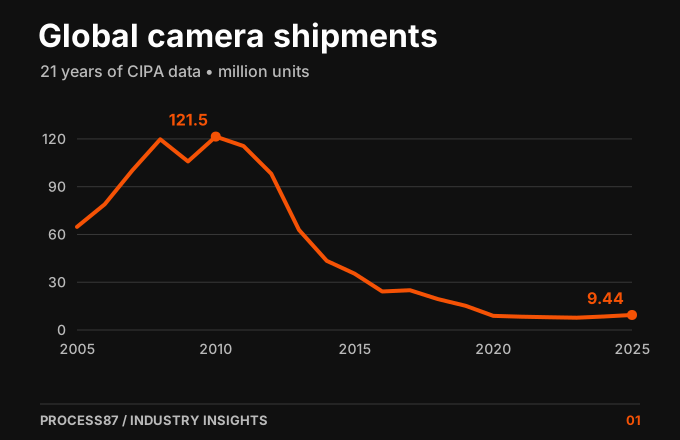
Chart data and description
| Year | Shipments (units) |
|---|---|
| 2005 | 64766923 |
| 2006 | 78981429 |
| 2007 | 100367056 |
| 2008 | 119756808 |
| 2009 | 105863632 |
| 2010 | 121463234 |
| 2011 | 115524250 |
| 2012 | 98139157 |
| 2013 | 62839653 |
| 2014 | 43434408 |
| 2015 | 35395457 |
| 2016 | 24189870 |
| 2017 | 24978486 |
| 2018 | 19423371 |
| 2019 | 15216957 |
| 2020 | 8886292 |
| 2021 | 8361521 |
| 2022 | 8011598 |
| 2023 | 7720505 |
| 2024 | 8490227 |
| 2025 | 9438876 |
21 years of CIPA data • million units
Shipments grew 11.2% in 2025, from a base still about 92% below the 2010 peak. The market also changed shape. CIPA counted 16.2 million DSLRs and 4.0 million mirrorless cameras in 2012. By 2025, those numbers were 0.69 million and 6.31 million. Mirrorless made up about 90% of interchangeable-lens body shipments. Fixed-lens cameras grew 29.6% in 2025 to 2.44 million, a small fraction of what the category once shipped. A premium compact such as the Ricoh GR IV now serves a more specific need than the family holiday camera of the compact boom. C1 C2 F8
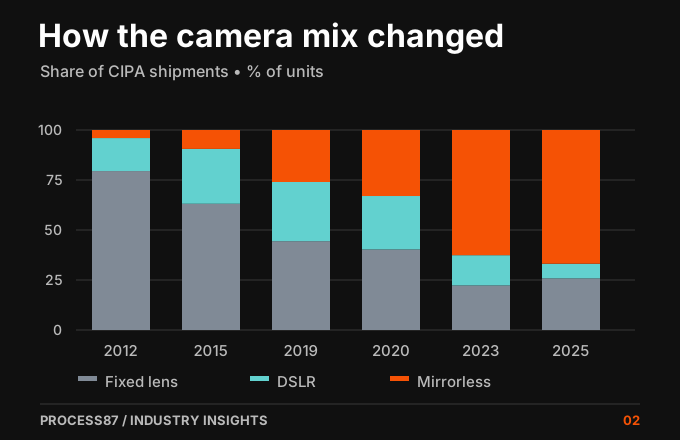
Chart data and description
| Year | Fixed lens | DSLR | Mirrorless |
|---|---|---|---|
| 2012 | 79.5% | 16.5% | 4.0% |
| 2015 | 63.1% | 27.4% | 9.5% |
| 2019 | 44.4% | 29.6% | 26.0% |
| 2020 | 40.3% | 26.7% | 33.0% |
| 2023 | 22.3% | 15.1% | 62.6% |
| 2025 | 25.8% | 7.3% | 66.9% |
Share of CIPA shipments • % of units
Volume and value have moved apart
The value of camera shipments reached JPY 880.6 billion in 2025, up 6.8% year on year. Average value per shipped camera fell from about JPY 97,100 to JPY 93,300 because units grew faster than value. In 2010, the same calculation produced about JPY 13,500. This is nominal shipment value divided by units. Product mix and exchange rates affect the result, so it should never be read as a retail price or a profit margin. C1 C2
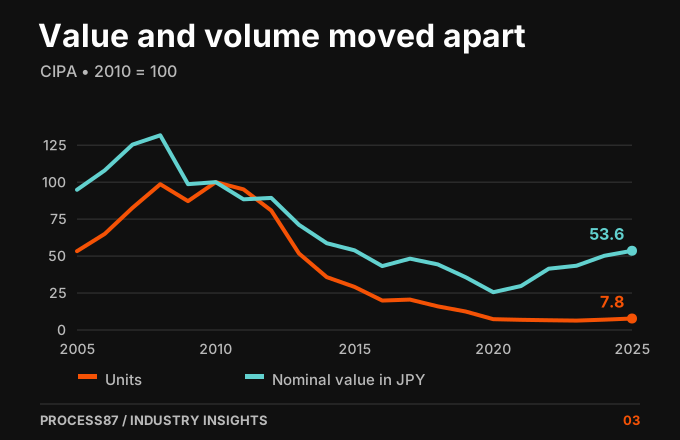
Chart data and description
| Year | Units (2010=100) | Value (2010=100) |
|---|---|---|
| 2005 | 53.3 | 94.9 |
| 2006 | 65.0 | 108.0 |
| 2007 | 82.6 | 125.4 |
| 2008 | 98.6 | 131.7 |
| 2009 | 87.2 | 98.6 |
| 2010 | 100.0 | 100.0 |
| 2011 | 95.1 | 88.4 |
| 2012 | 80.8 | 89.3 |
| 2013 | 51.7 | 71.1 |
| 2014 | 35.8 | 58.7 |
| 2015 | 29.1 | 53.9 |
| 2016 | 19.9 | 43.2 |
| 2017 | 20.6 | 48.2 |
| 2018 | 16.0 | 44.4 |
| 2019 | 12.5 | 35.7 |
| 2020 | 7.3 | 25.6 |
| 2021 | 6.9 | 29.8 |
| 2022 | 6.6 | 41.5 |
| 2023 | 6.4 | 43.5 |
| 2024 | 7.0 | 50.2 |
| 2025 | 7.8 | 53.6 |
CIPA • 2010 = 100
| CIPA shipments, January to September | 2025 | 2026 | Year on year |
|---|---|---|---|
| All digital still cameras | 6.741m | 6.452m | −4.3% |
| Built-in lens | 1.674m | 1.932m | +15.4% |
| Mirrorless | 4.540m | 4.180m | −7.9% |
| DSLR | 0.527m | 0.340m | −35.5% |
| Interchangeable-lens bodies, 35 mm or larger | 1.863m | 1.492m | −19.9% |
| Interchangeable lenses | 7.671m | 7.155m | −6.7% |
The sensor-size row cuts across interchangeable-lens bodies. It cannot be added to the DSLR and mirrorless rows. Lenses are counted separately. CIPA recorded 10.60 million lenses in 2025, up 2.8%. Through September 2026, lens shipments fell but their nominal value rose 3.1%. CIPA added a company to its camera statistics from January 2026, which affects year-on-year comparability. The table covers nine months only. C3 C4 C5 C6
DJI, Insta360 and GoPro: a different kind of growth
IDC estimates that 16.65 million handheld smart cameras shipped worldwide in 2025, up about 83%, with sales value above CNY 46.1 billion. DJI accounted for 10.4 million units, Insta360 for 3.4 million and GoPro for 1.8 million. IDC defines the category around portable consumer imaging devices with processing, stabilisation and at least 2K resolution. It covers action, 360 and gimbal cameras. It is separate from CIPA still-camera reporting, smartphones and camera drones. I1 I5
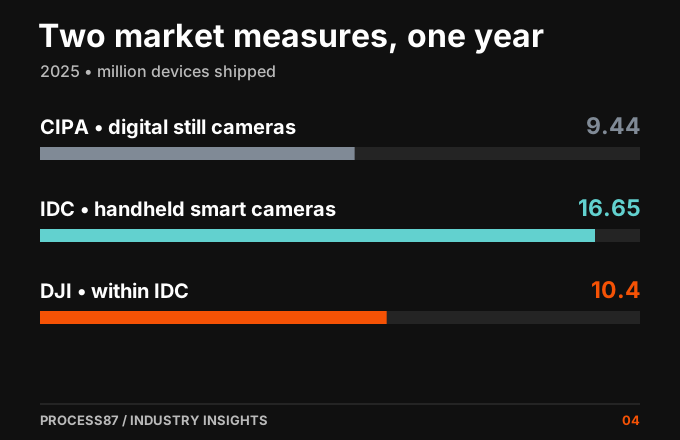
Chart data and description
| Scope | Million units |
|---|---|
| CIPA | 9.44 |
| IDC | 16.65 |
| DJI (IDC) | 10.4 |
2025 • million devices shipped
IDC recorded 4.14 million units in Q1 2026, up 33% year on year, and more than 5.88 million in Q2, up 57%. Gimbal cameras grew 87% in Q2, versus 47% for action cameras and 4% for 360. Launch timing, promotions and availability vary across quarters. These growth rates should not be multiplied into a full-year forecast. I2 I3
DJI has brought stabilisation, subject tracking and movement control from drones into handheld imaging. Its Pocket, Action and Osmo 360 ranges serve different jobs. Insta360 offers a different advantage: record the scene first and choose the frame later. It is expanding beyond 360 into small wearable cameras, gimbals and audio. In Q2, IDC put Insta360 at 73% of the 360 subcategory and 20% of handheld smart cameras overall. Together, DJI and Insta360 accounted for about 93% of the wider category in that quarter. That supports a clear claim about two Chinese firms in one market, rather than a claim about all cameras. I3 F10 F11
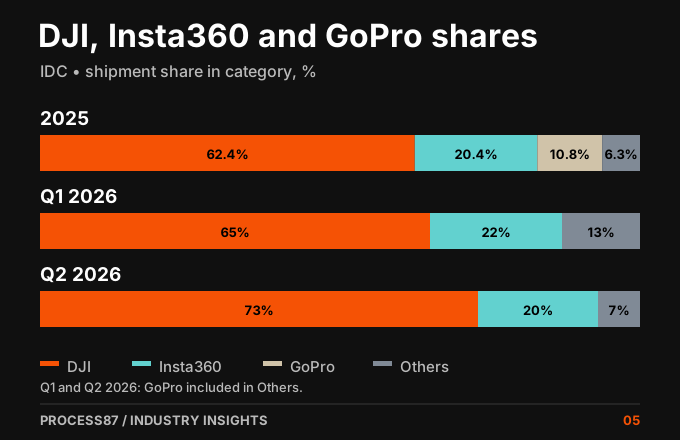
Chart data and description
| Period | DJI | Insta360 | GoPro | Others |
|---|---|---|---|---|
| 2025 | 62.4% | 20.4% | 10.8% | 6.3% |
| Q1 2026 | 65.0% | 22.0% | in Others | 13.0% |
| Q2 2026 | 73.0% | 20.0% | in Others | 7.0% |
IDC • shipment share in category, %
GoPro's amended annual filing records 1.826 million camera shipments net of returns in 2025. Its original results release put sell-through at about 2 million. Both can be true: shops can sell stock received in an earlier period. GoPro reported USD 651.5 million in revenue, including USD 106.3 million from subscriptions and services, and a net loss of about USD 92.6 million. Its amended Q2 filing cites inventory reductions in the channel and substantial doubt about the ability to continue as a going concern. MISSION 1 is a move towards more demanding video work. Product ambition has yet to resolve the financial pressure. F13 F14 F15
Insta360 faces a different challenge. Arashi Vision's 2025 revenue rose 74.8% to CNY 9.74 billion, but profit attributable to shareholders fell 6.6%. In the first nine months of 2026, revenue grew 42.7% year on year while attributable profit fell about 94%. Investment and expansion have a cost, even in a growing category. A comparable financial breakdown for DJI's handheld business is unavailable in the sources reviewed. F11 F12
Trade rules have a narrower reach than the headlines suggest. The US FCC included foreign-produced drones and critical components on its Covered List, subject to exceptions and conditional approvals. That affects US equipment authorisation and should not be extended automatically to handheld cameras. The EU has its own drone product requirements. For cross-border shoots, check the availability, accessories and support of the specific model in the country of production. T1 T2 T3
How established camera makers are responding
| Company | What the disclosures and products show |
|---|---|
| Canon | Its Cameras category recorded JPY 158.8 billion in Q3 2026, up 4.0% in yen and down 3.6% in local currencies. EOS spans stills and video. Currency, tariffs and parts costs complicate the growth story. F1 M2 |
| Sony | ET&S Imaging recorded JPY 723.6 billion for the year to March 2026, against JPY 739.3 billion on a comparable basis. The category includes bodies, lenses and other imaging solutions. Alpha and Cinema Line reach photographers and filmmakers; Sony reports its sensor business separately. F2 |
| Nikon | Imaging Products recorded JPY 129.3 billion in the six months to September 2026, against JPY 145.0 billion a year earlier. The ZR points towards digital cinema while segment volume and profit are under pressure. F3 F4 |
| Fujifilm | In the quarter to September 2026, Professional Imaging revenue fell 5.1% while Consumer Imaging grew 22.5%. Growth in the combined segment tells us little about the individual trajectories of X, GFX and instax. F5 |
| Panasonic / LUMIX | The S1II and open-gate recording make sense for hybrid crews adapting footage for several formats. We did not find a comparable standalone LUMIX result. F6 |
| OM System | The OM-3 and Micro Four Thirds offer portability and computational tools. Product positioning is clearer than the public evidence on margins or market share. F7 |
| Ricoh / Pentax | The APS-C GR IV serves the premium compact niche, while Pentax maintains an optical DSLR proposition. Separate results for those lines are not available in the sources reviewed. F8 F9 |
Does AI make cameras and memory cards more expensive?
DRAM helps a camera buffer and process data. NAND retains it in cards, internal storage and drives. Data-centre demand for server memory and enterprise SSDs can change which products memory suppliers prioritise. In September, TrendForce forecast quarter-on-quarter contract price increases of 10–15% for conventional DRAM and 15–20% for NAND Flash in Q4 2026. This is a component procurement forecast. It cannot tell us what a particular camera or card costs in a shop. M1 M7
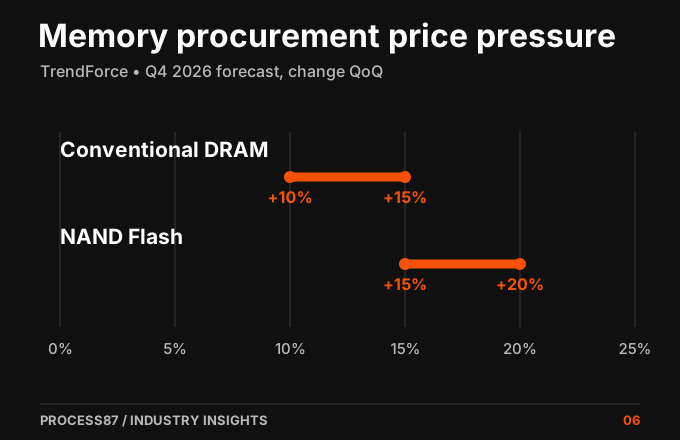
Chart data and description
| Memory | Min. | Max. |
|---|---|---|
| Conventional DRAM | 10% | 15% |
| NAND Flash | 15% | 20% |
TrendForce • Q4 2026 forecast, change QoQ
Some manufacturers have put numbers or explanations on the pressure. Fujifilm reported a JPY 2.5 billion impact from semiconductor memory prices on quarterly Imaging operating income. GoPro attributed some price increases to both memory and tariffs. Canon outlined a policy of passing on higher costs from 2027. There is no uniform pass-through figure for cameras or cards in the UK or Poland. Currency, stocks, promotions and decisions by suppliers and retailers all matter. F5 F14 M2 M3
On set, minimum sustained write speed is more relevant than the fastest number printed on a card. V60 and V90 indicate 60 and 90 MB/s minimum sustained writes in a compatible configuration. SD Express has separate classes. CFexpress Type A and B use different formats and performance envelopes; VPG applies to sustained performance under a specified profile. A 400 Mb/s video stream alone works out to 50 MB/s before allowing for overhead and the camera's requirements. RAW bursts also need the buffer to clear quickly. Test the card in the actual recording mode before a job. M4 M5 M6
What we checked in the Northrups' video
The description of Tony and Chelsea Northrup's 8 November video gives a 3.2% fall in shipments, a near 20% decline in full frame and a roughly 15% gain for compacts. Those directions and figures agree with January to August, with one distinction: the CIPA row covers 35 mm and larger. September figures were available by the date of the video. Rising shipment value, the compact rebound and growth in handheld cameras make a general collapse an overstatement. Price increases support a narrower case for cost pressure. We reviewed the available description and chapters, as a complete transcript was unavailable. V1 V2 C3 C7
What AI changes in studio work
Subject-recognition autofocus helps capture an actual event. A mask or denoising tool helps edit an existing image. Generating a background, a person or a whole picture may introduce content that was never on set. Each use calls for a different level of review. The ILO studies exposure of tasks to change; it does not give us a count of jobs likely to disappear in British or Polish studios. A1
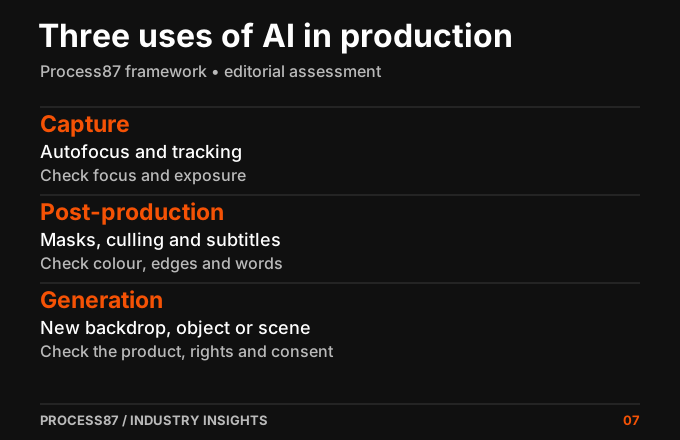
Chart data and description
| Stage | Use | Check |
|---|---|---|
| Capture | Autofocus and tracking | Check focus and exposure |
| Post-production | Masks, culling and subtitles | Check colour, edges and words |
| Generation | New backdrop, object or scene | Check the product, rights and consent |
Process87 framework • editorial assessment
| Job | Where production can get easier | What still needs checking |
|---|---|---|
| Product and e-commerce | Masks, repeat crops and format adaptations. | Colour, finish, labels, dimensions and the exact SKU. |
| Advertising campaigns | Previsualisation, background variants and adaptations. | The creative idea, brand, rights and whether the image supports the promise being made. |
| Food | Background clean-up, layouts and channel variants. | The actual portion, ingredients, lighting and what the customer receives. |
| Interiors and architecture | Selection, baseline corrections and selective retouching. | Geometry, materials, lighting and condition. A visualisation and a record of a real space serve different purposes. |
| Headshots and events | Culling, base corrections and captions. | Identity, consent, the record of the event and natural-looking retouching. |
| Video and social | Transcription, subtitles, rough selection and reframing. | Sound, continuity, colour matching and what survives each final crop. |
Poland operates in the EU transparency framework. The UK has its own context. Obligations depend on the material and how it is used. Agree in advance what may be generated, who signs off changes and how original files and edits will be recorded. C2PA metadata can record provenance and editing history. It cannot prove that a scene is true. A2 A3 A5
Three scenarios for 2027–2030
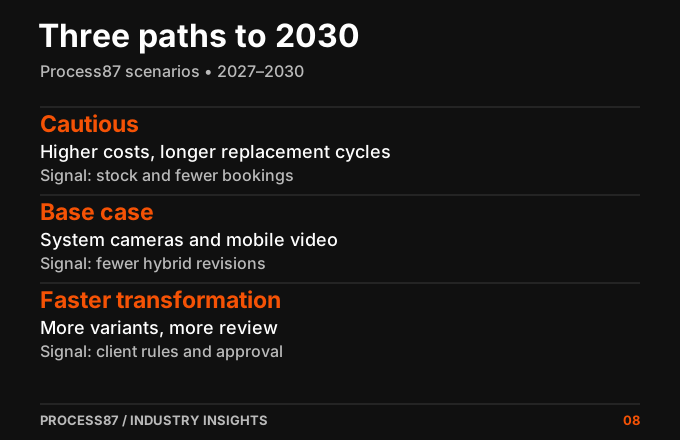
Chart data and description
| Scenario | Assumption | Signal |
|---|---|---|
| Cautious | Higher costs, longer replacement cycles | Signal: stock and fewer bookings |
| Base case | System cameras and mobile video | Signal: fewer hybrid revisions |
| Faster transformation | More variants, more review | Signal: client rules and approval |
Process87 scenarios • 2027–2030
Cautious. High costs and weaker demand extend replacement cycles. DSLRs and equipment without a distinct use face the greatest pressure. A studio can rent for individual jobs and run its existing kit for longer. Watch stock levels, shipment value and client bookings. Cheaper components and a broad recovery would weaken this scenario.
Base case. System cameras remain important where lighting, optics and consistency matter. Smaller cameras make frequent filming easier. AI takes on selected tasks where the savings survive review and revisions. The coexistence of the two camera markets supports this view. A prolonged slowdown in handheld imaging or a lack of measurable savings on approved assets would challenge it.
Faster transformation. Lightweight capture, remote approval and generated variants become more tightly integrated. Routine, interchangeable assets face price pressure, and verifiable records become more valuable. Consistent output and client acceptance are prerequisites. Rights, product accuracy and rising revision costs could slow adoption. Watch what buyers specify in briefs and how often hybrid assets pass review. C3 I3 M1 A1
What Process87 and our clients can take from this
For the next 12 months, put the basics first: a joint stills and video shot list, a consistent approach to lighting and colour, an archive of originals and a final product check. Then test automation on one repeatable task and count the time including corrections. Buy hardware when it solves a recurring problem that the existing kit or occasional hire cannot solve efficiently.
A combined stills and video day works when both formats can share the set and talent. Moving footage may still need separate lighting, sound and rehearsal. A recurring content package makes sense when the brand has a predictable publishing rhythm and can agree formats and sign-off in advance. Hybrid post-production is strongest when a real product image remains the reference. These are approaches to test, rather than an announcement of new Process87 services.
The biggest opportunity we see is getting more usable formats from well-planned material. The real risk is pressure on the price of routine assets while the cost of checking them is underestimated. We put less weight on one new camera or on promises that automation alone will improve margins. Clients pay for material that represents the product or event, fits the brand and is ready to use. Equipment, lighting, production planning and retouching all contribute to that outcome.
For more on planning stills and video together, see Process87 visual production.
Method: CIPA reports shipments from participating companies; IDC estimates a separate category; corporate figures refer to the periods and business units stated. The studio notes and scenarios set out Process87's proposed editorial assessment.
Sources and data
- C1 · CIPA • roczne tabele aparatów / annual camera tables, 2005–2025
- C2 · CIPA • styczeń–grudzień / January–December 2025
- I5 · IDC • oryginalna tabela dostaw wg marek 2025 / original vendor table
- C3 · CIPA • styczeń–wrzesień / January–September 2026
- C4 · CIPA • styczeń–wrzesień / January–September 2025
- I3 · IDC • Worldwide Quarterly Handheld Smart Camera Tracker, Q2 2026
- F14 · GoPro • Q2 2026 amended Form 10-Q/A
- I4 · IDC • Worldwide Quarterly Smartphone Tracker
- F8 · Ricoh Imaging • GR IV launch
- C5 · CIPA • wyniki 2025 i prognoza 2026 / results and outlook
- C6 · CIPA • obiektywy, styczeń–wrzesień / lenses, January–September 2026
- I1 · IDC • Worldwide Quarterly Handheld Smart Camera Tracker, 2025
- I2 · IDC • Worldwide Quarterly Handheld Smart Camera Tracker, Q1 2026
- F10 · DJI • handheld product lines
- F11 · Arashi Vision • FY2025 annual report, issuer document
- F13 · GoPro • FY2025 amended Form 10-K/A
- F15 · GoPro • 2025 results, sell-through disclosure
- F12 · Arashi Vision • Q3 2026 filing, issuer document
- T1 · FCC • foreign-produced UAS and critical components
- T2 · FCC • conditional approvals and exemptions
- T3 · EUR-Lex • delegated regulation (EU) 2019/945
- F1 · Canon • Q3 2026, presentation and commentary
- M2 · Canon • Q3 analyst Q&A
- F2 · Sony • FY2025 supplemental information, ET&S Imaging
- F3 · Nikon • Imaging Products, FY ended March 2026
- F4 · Nikon • H1 ended September 2026, financial and business data
- F5 · Fujifilm • FY2026 Q2, business summary, Imaging
- F6 · Panasonic • LUMIX S1II/S1IIE, UK announcement
- F7 · OM SYSTEM • OM-3
- F9 · Pentax • K-3 III technical documentation
- M1 · TrendForce • Q4 2026 memory contract-price forecast
- M7 · Micron • FY2026 Q4 and full-year release
- M3 · Fujifilm Japan • domestic price revision
- M4 · SD Association • Speed Class
- M5 · CompactFlash Association • Video Performance Guarantee
- M6 · CompactFlash Association • Card Types
- V1 · Tony & Chelsea Northrup • The End Of The Camera Industry As We Know It
- V2 · Kopia opisu i rozdziałów / mirror of description and chapters
- C7 · CIPA • styczeń–sierpień / January–August 2026
- A1 · ILO • Generative AI and the media and culture industry
- A2 · EU AI Act Service Desk • Article 50
- A3 · UK Government • Copyright and Artificial Intelligence report
- A5 · C2PA • Content Credentials Explainer
- V4 · Adobe • completed acquisition of Topaz Labs